
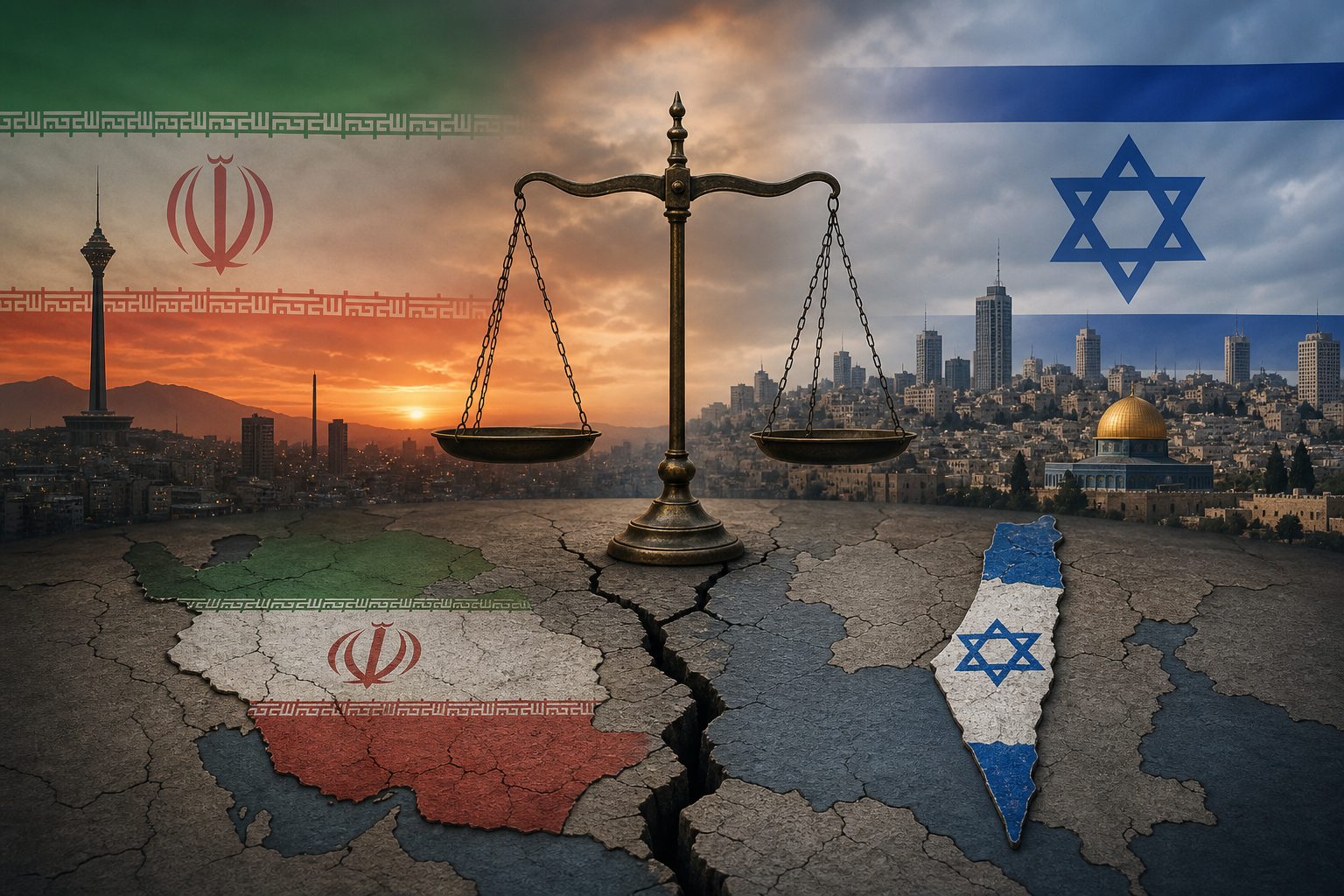
Does Iran's Islamic Republic want to destroy Israel and eliminate its people? The short answer from Tehran's own statements is that Iran seeks the end of Israel as a state — what its leaders call the "Zionist regime" — while insisting they do not oppose Jewish people as such. Israeli officials read those words as an existential threat backed by missiles, proxies, and a nuclear program moving closer to weapons-grade material. The result is a confrontation in which each side describes the other as bent on annihilation, and in which civilians on both sides — and across the wider Middle East — have paid a steep price.
What Iran's leaders say — and what they deny
Since the 1979 Islamic Revolution, opposition to Israel has been a pillar of Iranian state ideology. Ayatollah Ruhollah Khomeini, the revolution's founder, cut diplomatic ties with Israel and cast it as an illegitimate "Zionist regime" that must be abolished (Iran International). His successor, Supreme Leader Ali Khamenei, has repeatedly called Israel a "cancerous tumor" that "should certainly be eradicated" (The Times of Israel).
In October 2025, a cleric close to Khamenei unveiled a state-published book titled Israel Annihilation Plan: The Islamic Republic's Strategy for the Destruction of the Zionist Regime at a ceremony in Qom. Its author said the volume explained "the theoretical and strategic foundations of Iran's plan to end the life of this regime" and linked the June 2025 war with Israel to that broader strategy (Iran International). Israeli Foreign Minister Gideon Sa'ar told the United Nations Security Council that Iran's nuclear ambitions, missile buildup, and support for regional armed groups formed part of a concrete plan to "annihilate" Israel — "not mere rhetoric" (The Times of Israel — Sa'ar at UN).
Iranian officials also draw a distinction. Khamenei has said that "the elimination of the government of Israel does not mean the elimination of Jews" and that Iran has "no issue with Jewish people," proposing instead a referendum of Muslims, Christians, and Jews in historic Palestine (Ynetnews). Critics counter that regime rhetoric often blurs anti-Zionism and antisemitism, citing Holocaust denial, dehumanizing language, and attacks on Jewish figures (The Times of Israel — Khamenei antisemitism analysis). Iran hosts a small Jewish community, but the state's official line remains the removal of Israel as a sovereign Jewish-majority state (Wikipedia — Khamenei political positions).
A regime that enforces its ideology at home
The editor's brief asked how Iran treats its own citizens. International monitors describe a government that uses law, violence, and the death penalty to enforce religious and political conformity.
Human Rights Watch reported that Iran carried out more than 2,000 executions in 2025 — the highest known total in decades — and that consensual same-sex relations remained criminalized with punishments ranging from flogging to death (Human Rights Watch — Iran 2026 report). Amnesty International documented arbitrary detention, torture, and systemic discrimination against women, LGBTI people, and ethnic and religious minorities (Amnesty International — Iran). The European Union Asylum Agency noted that blasphemy can be punished by death and that apostates and atheists face prosecution, arbitrary detention, and torture (EUAA — Iran country guidance). The BBC reported at least 1,639 executions in 2025, the highest figure since 1989, with drug and murder convictions making up the vast majority of cases (BBC News — Iran executions 2025).
These domestic practices are separate from the Israel conflict, but they shape how outside observers frame the regime: a theocratic state that justifies harsh punishment in religious terms while projecting revolutionary ideology abroad.
From newspapers to battlefields: proxies and direct war
Iran does not share a border with Israel. Its challenge to the Jewish state has operated through ideology, funding, and armed allies — what Tehran and analysts call the "axis of resistance."
The U.S. State Department has long designated Iran the "foremost state sponsor of terrorism," citing support for Hezbollah, Hamas, and other groups (AJC — Iran terror network). Researchers at West Point's Combating Terrorism Center traced how Iran rebuilt ties with Hamas and Palestinian Islamic Jihad after the Syrian civil war, with reported funding to Hamas reaching roughly $100 million annually by 2023 (CTC West Point — Path to October 7). Academic analysis of state responsibility notes that while Iran does not exercise full command and control over Hamas, it has supplied weapons, training, and financing that facilitated attacks including those of 7 October 2023 (Reading University — Iran and proxies PDF).
Direct war broke out in June 2025. Israel launched Operation Rising Lion on 13 June, striking nuclear sites, missile infrastructure, and military leadership across Iran (France 24 — 12-day war). Iran retaliated with hundreds of ballistic missiles and drones (Wikipedia — Twelve-Day War timeline). On 22 June, the United States joined with Operation Midnight Hammer, using B-2 bombers against hardened sites at Fordow, Natanz, and Isfahan (France 24 — 12-day war). A ceasefire took hold on 24 June, but hostilities resumed on a larger scale in February 2026.
Casualties: a comparison that is not symmetrical
Both governments portray the other as an aggressor seeking mass death. The numbers tell a more complicated story about scale and who bears the cost.
In the June 2025 Twelve-Day War, Iran fired more than 550 ballistic missiles and over 1,000 drones at Israel; Israeli strikes hit military and nuclear targets but also residential areas in Tehran (Wikipedia — Twelve-Day War timeline). The broader 2026 war that began on 28 February has produced sharply unequal tolls. As of early June 2026, Iran's health ministry reported at least 3,468 people killed and more than 26,500 injured in U.S.–Israeli strikes (Al Jazeera — casualty tracker). Human Rights Activists in Iran (HRANA), an independent NGO, documented 3,636 deaths in Iran, including roughly 1,701 civilians (Wikipedia — 2026 war casualties).
Inside Israel, the same tracker recorded at least 60 Israeli citizens or residents killed and nearly 9,000 injured from Iranian missile and drone attacks (Wikipedia — 2026 war casualties). Lebanon — where Israel and Hezbollah fought in parallel — reported more than 3,500 killed (Al Jazeera — casualty tracker). Fifteen U.S. service members had also been killed as of June 2026 (Wikipedia — 2026 war casualties).
Proxy conflicts add another layer. Hamas's 7 October 2023 attack killed more than 1,200 people in Israel, mostly civilians, and took more than 250 hostage (AJC — Iran terror network). Israel's subsequent war in Gaza has killed tens of thousands of Palestinians, according to the Hamas-run health ministry and UN figures cited by the Council on Foreign Relations (CFR — U.S. aid to Israel).
Neither side's leadership rhetoric explicitly calls for the extermination of all civilians on the other side. In practice, both have authorized or enabled violence that kills non-combatants — Iran through proxies and indiscriminate missile salvos, Israel through airstrikes across Iran, Lebanon, and Gaza. The casualty ratios in the 2026 Iran war are not close: Iranian deaths outnumber Israeli deaths by a factor of roughly 50 to 1 in the figures reported above, before counting Lebanon or Gulf states caught in the crossfire.
The nuclear question — and how long Israel has sounded the alarm
Israeli Prime Minister Benjamin Netanyahu has warned for more than three decades that Iran is on the verge of a nuclear bomb. In 1992, as a Knesset member, he said Iran would be able to "develop and produce a nuclear bomb" within three to five years (Al Jazeera — Netanyahu rhetoric history). Foreign Minister Shimon Peres predicted a bomb by 1999; at the UN in 2012, Netanyahu displayed a cartoon bomb and said Iran could reach the threshold "by next spring, at most by next summer" (Al Jazeera — Netanyahu rhetoric history).
Those deadlines have repeatedly passed without Iran deploying a weapon. A 2007 U.S. National Intelligence Estimate judged that Tehran had halted an organized nuclear weapons program in 2003 (Jewish Home News — nuclear deadline history). The International Crisis Group notes that even producing fissile material is not the same as building a deliverable warhead — a process analysts estimate could take 18 months or more after enrichment (International Crisis Group — breakout time).
Iran denies seeking nuclear weapons and says its program is peaceful. Yet before the June 2025 strikes, it had enriched uranium to 60% purity — the only non-nuclear-weapons state under the Non-Proliferation Treaty to do so — and had accumulated 440.9 kg of that material, which experts say could be further enriched for multiple weapons (IAEA Board report — gov2026-8). IAEA Director General Rafael Grossi said there was "no evidence of Iran building a nuclear bomb," but that its stockpile and restricted inspector access were "cause for serious concern" (ANS — IAEA Iran update).
After U.S. and Israeli bombing in June 2025, the IAEA lost access to Iran's main enrichment sites and could no longer verify where its uranium stockpiles were (IAEA Board report — gov2026-8). Grossi said he believed "a bit more than 200 kg" of 60%-enriched uranium survived at an Isfahan tunnel complex (Quews News — Reuters Iran uranium explainer). Israel justified its June 2025 offensive partly on the grounds that Iran's nuclear and missile programs posed a "clear and present danger" to its survival (IDSF — Rising Lion report).
Has Israel used America to fight its wars?
A persistent claim holds that Israel draws the United States into wars on its behalf. The factual record is more nuanced.
There is no mutual defense treaty obligating U.S. troops to fight for Israel. Israel's military fights its own ground and air campaigns; American forces have not been deployed as combat divisions in Israel's wars against Arab states or Iran (Allyvia — U.S. has not fought Israel's wars). The 2003 invasion of Iraq was authorized by U.S. law citing American national security concerns, not an Israeli request for American troops (Allyvia — U.S. has not fought Israel's wars). Netanyahu did advocate for the Iraq war before Congress in 2002, linking Iraq and Iran to nuclear proliferation (Al Jazeera — Netanyahu rhetoric history).
What the United States has provided is extensive military aid, intelligence sharing, diplomatic cover, and — increasingly — direct participation in regional combat. Israel is the largest cumulative recipient of U.S. foreign assistance since its founding, receiving more than $300 billion in inflation-adjusted aid (CFR — U.S. aid to Israel). Since 7 October 2023, Brown University's Costs of War Project estimated U.S. spending of $31–34 billion on military aid to Israel and related regional operations (Al Jazeera — U.S. funded Israel's wars).
In April and October 2024, U.S. forces helped intercept Iranian missile and drone barrages aimed at Israel (CFR — U.S. aid to Israel). In June 2025 and again in 2026, American bombers and warships struck Iran directly alongside Israel (France 24 — 12-day war). So while Israel has not "used" America to fight separate wars in the sense of deploying U.S. infantry in its place, the two allies' military campaigns against Iran, Hezbollah, and Hamas have become deeply intertwined — with American weapons, money, and, in the Iran case, American pilots.
Likely outcomes
Several scenarios compete, none reassuring.
If Iran's regime survives, its leaders have shown no sign of abandoning hostility toward Israel. The October 2025 Annihilation Plan book suggests the June 2025 war is viewed in Tehran as a chapter in a longer strategy, not a closing chapter (The Week — Iran annihilation book). If Iran eventually acquires a nuclear weapon — a step U.S. intelligence has not confirmed it has taken — the regional balance would shift sharply. Grossi and other experts warn that even without a bomb, surviving highly enriched uranium and degraded inspections create proliferation risk (IAEA Board report — gov2026-8).
Israel, backed by Washington, has demonstrated willingness to strike inside Iran preemptively. Netanyahu continues to argue that without intervention, Iran could produce a weapon in "months, even weeks" (Al Jazeera — Netanyahu rhetoric history). Each round of strikes degrades Iranian capability but also deepens mutual enmity and civilian suffering.
A negotiated settlement remains possible — ceasefire talks in 2026 have touched on Iran's uranium stockpile (Quews News — Reuters Iran uranium explainer) — but neither government has accepted the other's legitimacy. Until that changes, the headline question will remain partly answered in rhetoric and partly in body counts: Iran's state doctrine calls for ending Israel as a country; Israel's security doctrine treats that as a license for war; and the people caught between them — Iranian, Israeli, Lebanese, Palestinian, and American — continue to die in disproportionate numbers.
References
- AJC — Hezbollah, Hamas, and Iran's terror network
- Al Jazeera — How the U.S. funded Israel's wars
- Al Jazeera — History of Netanyahu's Iran nuclear rhetoric
- Al Jazeera — U.S.-Israel attacks on Iran casualty tracker
- Allyvia — Americans have not fought Israel's wars
- Amnesty International — Human rights in Iran
- ANS — IAEA updates on Iran nuclear facilities
- BBC News — Iran executions highest in decades
- CFR — U.S. aid to Israel in four charts
- Combating Terrorism Center — Path to October 7 and Iran's axis
- EUAA — Iran country guidance on apostasy and atheism
- France 24 — Looking back at the 12-day Israel-Iran war
- Human Rights Watch — World Report 2026: Iran
- IAEA — Board of Governors report on Iran safeguards (gov2026-8)
- IDSF — Operation Rising Lion security snapshot
- International Crisis Group — Iran nuclear breakout time
- Iran International — Khamenei aide unveils Israel annihilation plan book
- Jewish Home News — Thirty years of the Iranian nuclear deadline
- Quews News — Reuters explainer on Iran's enriched uranium
- Reading University — Iran and its proxies: attribution PDF
- The Times of Israel — Khamenei calls Israel a cancerous tumor
- The Times of Israel — Iran annihilation efforts justify offensive, Sa'ar tells UN
- The Times of Israel — Khamenei's descent into antisemitism
- The Week — Iran unveils book detailing plans to destroy Israel
- Wikipedia — Casualties of the 2026 Iran war
- Wikipedia — Political positions of Ali Khamenei
- Wikipedia — Timeline of the Iran-Israel war (Twelve-Day War)
- Ynetnews — Khamenei: Iran will support any group that fights Israel