
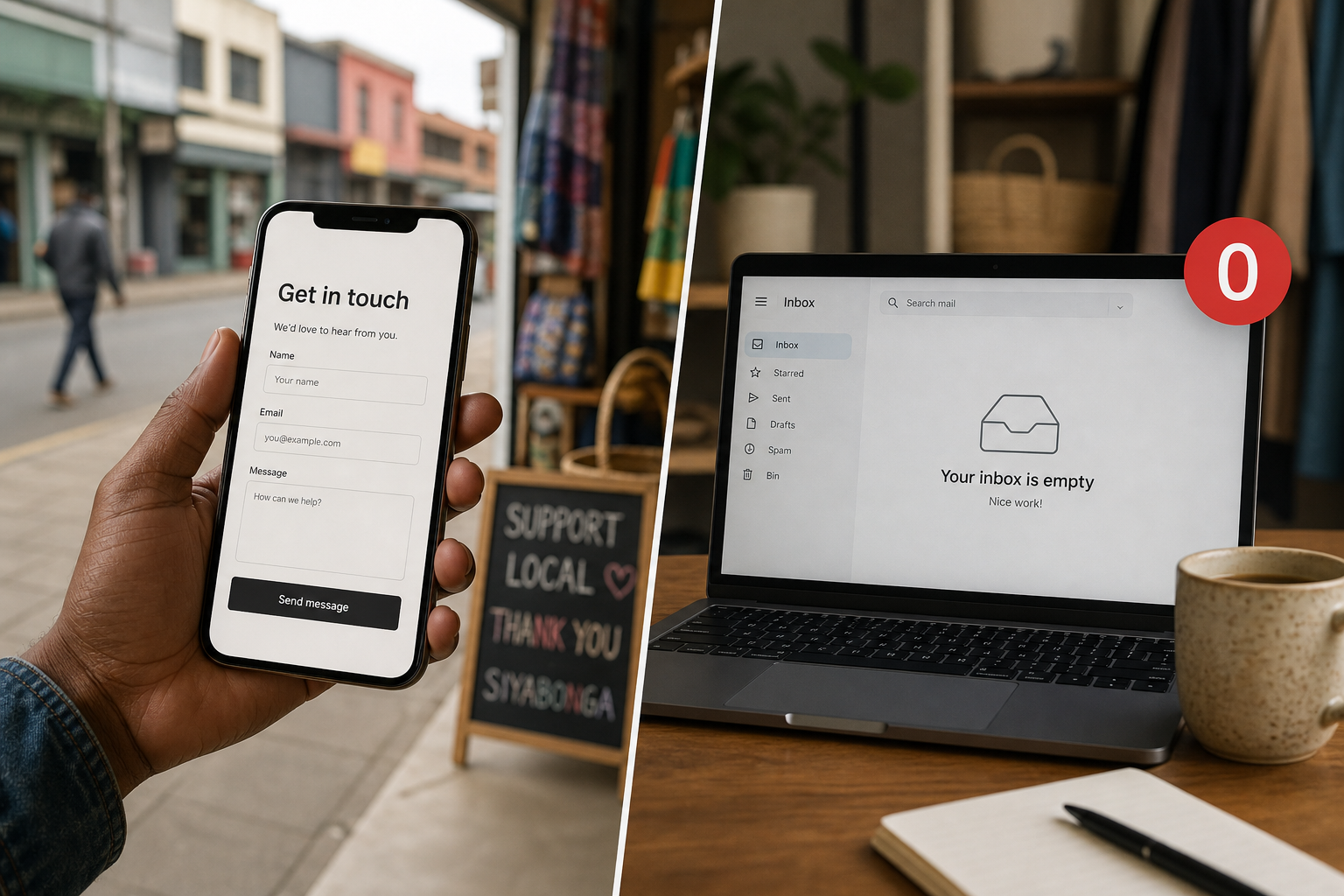
On a Saturday morning at a Riverside market stall, a baker’s phone buzzes with a WhatsApp order while a website enquiry sits unread in a shared Gmail tab opened three days ago. The form worked. The customer did the hard part. What failed was everything that should happen next.
Across South Africa’s high streets, home industries, and service trades, independent businesses have rushed to claim a corner of the web. Industry research suggests the intent is there: in Sage’s 2024 Small Business, Big Opportunity survey, 78% of small and medium businesses said digital technology plays an important role in their operations (Sage SBBO 2024 via EBnet). Xero’s 2026 State of South African Small Business report, based on more than 400 firms polled in January, found 85% prioritising digital adoption (Business Report). Yet for many owners, the contact page remains a checkbox — proof the business exists online — rather than part of how the shop actually runs.
The illusion of “done”
For a food producer in Magaliesberg, a hardware trader in Hartbeespoort, or a mobile mechanic covering the valley, launching a website often means choosing a template, uploading product photos, and dropping in a standard “Contact us” block. Once the form renders, the job feels complete.
That is a design milestone, not an operating one. A form that only fires an email — or worse, posts data into nowhere the owner routinely checks — creates a gap between what the customer believes happened and what the business can see, assign, and act on. The shopper assumes someone received the message. The owner assumes silence means no interest. Both sides lose.
Consumer research underscores why that gap matters. In DreamHost’s 2026 Local Business Trust Index, based on a survey of more than 1,200 United States consumers, 69% said a website is essential for credibility, and 67% ranked clear contact information as the most trust-building element on a site (DreamHost Trust Index). A visible form raises expectations. When nothing follows, trust erodes faster than it was built.
Where enquiries disappear
Email-only workflows look simple on paper. In practice they scatter responsibility.
Messages land in a personal inbox mixed with supplier invoices and newsletter clutter. They are filtered into spam because the sending address looks unfamiliar. A part-time assistant checks mail on Tuesdays. Two family members share one login and each assumes the other saw the alert. There is no record of who read what, when a reply went out, or whether the customer was ever contacted at all.
Field research on small-business contact forms paints a stark picture. In a 2025 study that submitted warm purchase-intent enquiries to 225 small-business websites and tracked responses for three weeks, 42.6% of leads received no reply whatsoever, first human responses averaged 17 hours and 49 minutes, and only 15.6% sent an automatic acknowledgement confirming receipt (Leadferno contact form research). Nearly 5% of forms tested were broken at submission. These were businesses ranking prominently in local search — not obscure pages nobody visits.
The pattern is not unique to one market. Harvard Business Review analysis of online sales leads, published in 2011 but still widely cited, found that 23% of audited companies never responded to a test enquiry, while the average response among those that did reply within 30 days was 42 hours (Harvard Business Review — The Short Life of Online Sales Leads). Firms that contacted prospects within an hour were nearly seven times more likely to qualify the lead than those that waited even sixty minutes longer.
Speed is not vanity; it is survival. Shoppers comparing three local upholsterers or jam makers will simply move to whoever answers first.
Before the inbox: forms that never finish
Lost enquiries begin before a message is ever sent. Form analytics firm Zuko, drawing on tens of millions of sessions, reports that contact and enquiry forms convert at 47.4% and 42.7% respectively from view to completion — among the lowest of any form type in its benchmarking database (Zuko form type benchmarking). On mobile, enquiry forms fall to 37.7% completion. More than a third of people who start typing abandon the process.
For traders whose customers already live on WhatsApp — academic research on South African micro-retailers notes that by 2023 96% of internet users in the country preferred the app for communication (SciELO — WhatsApp Business among SA retailers) — a clunky website form feels like an extra chore. If the mobile layout is awkward or the confirmation screen vague, the shopper returns to a channel where replies feel immediate.
A systems problem, not a prettier page
The fix is rarely another redesign. It is treating enquiries the way a shop treats stock or appointments: as items that must be captured, visible, and owned.
That means moving beyond “email me when someone submits.” It means storing each enquiry in a single operations view tied to the business — a place where the owner, and anyone who helps run the shop, can see new messages, mark them handled, and spot gaps before a customer gives up. Pair that with instant notification to an address someone actually monitors, and the guesswork shrinks. Was the form submitted? Yes. Who is handling it? Clear. Has anyone replied? Traceable.
Contrast that with the email-only default. No audit trail when a message vanishes in spam. No shared picture when an owner is at a market and a bookkeeper handles weekday mail. No way for a web support partner to see the same queue and help chase unanswered leads. The website looks professional; the back office stays invisible.
Independent retailers already understand channel preference locally. WhatsApp carries daily orders for many food producers and service providers. Email holds quotes, attachments, and formal requests. A contact form should feed that reality — not sit in a silo — by landing enquiries where the business already works and where follow-up can be measured.
What owners can ask without rebuilding everything
The questions are practical, not technical. Does every submission create a record someone checks daily? Does the customer get immediate confirmation with a realistic reply window? Can more than one person see pending enquiries without forwarding chains? Is there a simple way to know how long leads sit unanswered?
Industry surveys suggest South African small firms are investing in digital tools — 81% of SMEs in an eight-country African study, with strong South African representation, saw cloud-based services as essential to competitiveness (Vodacom SME report via Extensia) — yet many still treat the website contact form as decoration. Until enquiry handling sits inside the same operational habit as answering the shop phone, websites will keep leaking the customers they were built to win.
For Riverside traders, that may mean fewer lost jam orders, missed upholstery quotes, and silent weekend form fills. The form on the screen is only the front door. What happens on the other side decides whether anyone walks in.
References
- Driving economic resilience through digital transformation of South Africa’s SMB sector — EBnet
- SA small businesses prioritise stability and digital growth in 2026, Xero report finds — Business Report
- DreamHost 2026 Local Business Trust Index
- RESEARCH: Website Contact Forms and Lead Management — Leadferno
- The Short Life of Online Sales Leads — Harvard Business Review
- Zuko form type benchmarking
- WhatsApp business as a digital engagement tool among South African small and micro-retailers — SciELO
- For 81% of African SMEs, cloud computing is essential for their competitiveness — Extensia